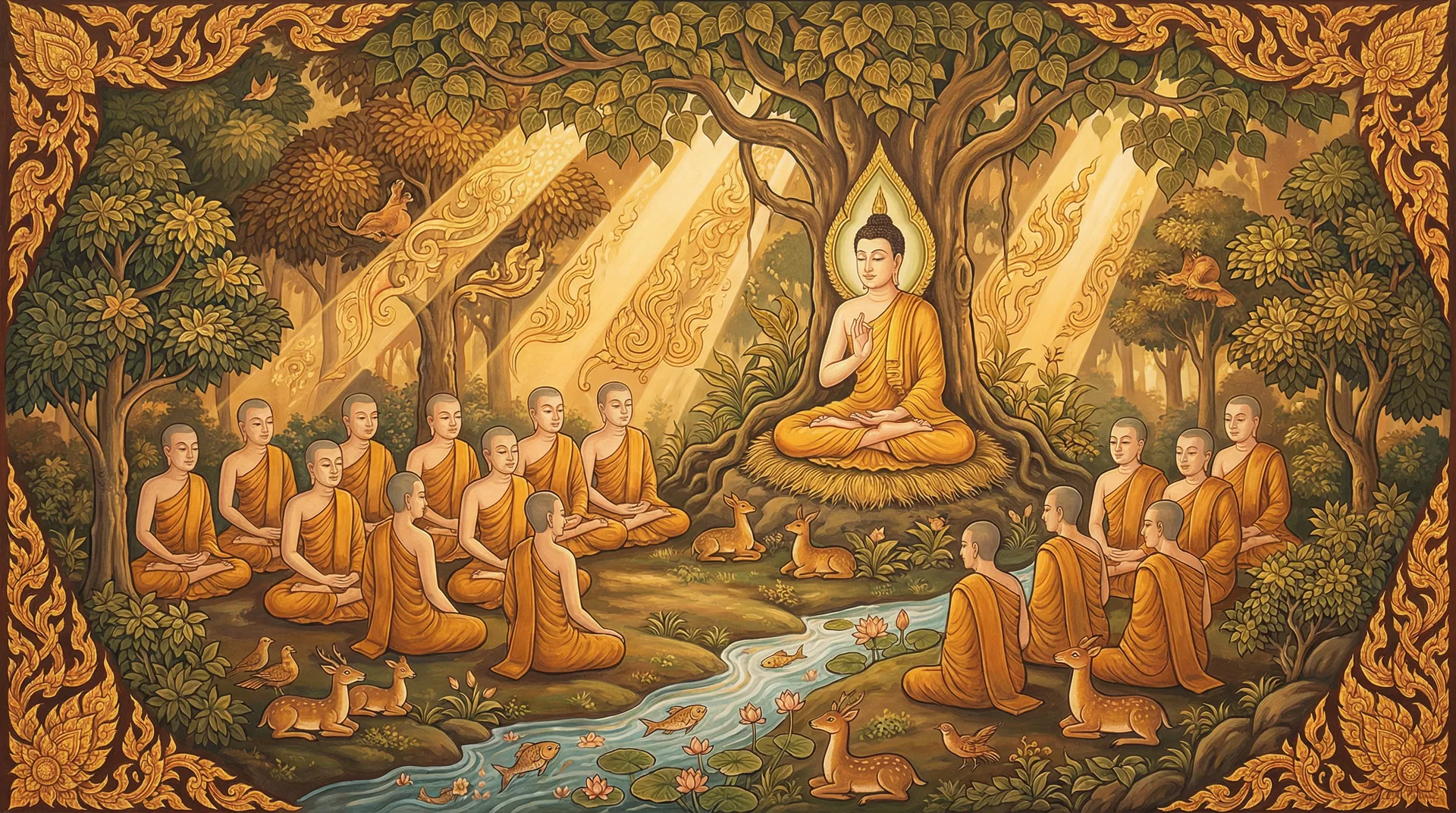
Samyuttakapālajātaka
The Tale of the Broken Pot
In the heart of a vibrant city, known for its skilled artisans and bustling marketplaces, lived a potter named Kapila. Kapila was a man of great talent and dedication, his hands shaping clay into vessels of exquisite beauty. He took immense pride in his work, each pot, bowl, and vase a testament to his skill and artistry. His reputation as the finest potter in the city was well-earned, and his workshop was always filled with eager customers.
However, Kapila possessed a flaw that often overshadowed his brilliance: he was easily angered and prone to fits of rage. When a customer was too demanding, when a piece did not turn out as perfectly as he envisioned, or even when the weather was not to his liking, Kapila would erupt. His temper was legendary, and his outbursts often scared away potential patrons and strained his relationships.
One day, a wealthy merchant, known for his discerning taste and his shrewd business dealings, commissioned Kapila to create a large, ornate urn. This urn was to be a centerpiece for a grand feast the merchant was hosting, and he emphasized the absolute need for perfection. Kapila, eager to impress such a prestigious client, accepted the challenge with gusto, promising the merchant a masterpiece.
He worked tirelessly on the urn, his focus absolute. He selected the finest clay, meticulously shaped the form, and decorated it with intricate patterns. As the final firing in the kiln approached, Kapila felt a surge of pride and anticipation. This would be his finest creation yet, a testament to his mastery.
However, fate, as it often does, had other plans. As Kapila carefully removed the finished urn from the intense heat of the kiln, his hands, perhaps slightly too eager, slipped. The magnificent urn, moments away from its completion, tumbled to the ground and shattered into a thousand pieces. The sound of the breaking pottery echoed in the workshop like a death knell.
Kapila stared at the scattered shards, his face contorted with disbelief and then rage. The merchant’s words, his emphasis on perfection, his own ambition – it all came crashing down. A furious cry escaped his lips. He kicked at the broken pieces, his anger consuming him. He cursed the clay, the kiln, his own clumsy hands, and the very heavens.
As he raged, a wise old monk, who was passing by the workshop and had heard the commotion, cautiously entered. He observed Kapila’s destructive fury, his face a mask of anger, surrounded by the scattered fragments of what was once a beautiful creation.
The monk approached slowly. “My son,” he said gently, his voice calm and steady, “what has happened here?”
Kapila, still seething, turned to the monk. “See this!” he spat, gesturing wildly at the broken urn. “My masterpiece! Shattered! All my effort, all my skill, ruined by a moment’s carelessness! It is a disaster! Everything is lost!”
The monk looked at the broken pieces, then back at Kapila. “Indeed, the urn is broken,” he agreed softly. “But tell me, Kapila, is everything lost?”
Kapila scoffed. “What else is there to lose? My reputation is in tatters, the merchant will be furious, and my hard work is now just worthless dust!”
The monk picked up a large shard of the urn, its surface still bearing a trace of Kapila's intricate artwork. “Worthless dust, you say?” he murmured, turning the piece in his hand. “This ‘worthless dust’ still holds the shape you gave it, the beauty you imparted. Your skill is not lost, Kapila. Your knowledge is not lost. Only the form has changed.”
He then knelt down and began to gather the larger pieces of the broken urn. Kapila watched, his anger slowly subsiding, replaced by a bewildered curiosity. The monk, with surprising dexterity, began to arrange the shards, not to recreate the urn, but to form a mosaic. He carefully selected pieces, fitting them together to create a new, albeit different, pattern.
“You see, Kapila,” the monk explained, his hands still busy, “sometimes, when our grand plans are shattered, we are given an opportunity to create something else. We cannot always control the outcome, but we can control our response. Your anger blinds you to the possibilities that lie within these fragments. Instead of destroying what remains in your fury, perhaps we can use these pieces to create something new, something beautiful in its own way.”
Kapila watched as the monk, with patience and gentle effort, transformed the remnants of his shattered dream into a unique mosaic. It was not the grand urn he had envisioned, but it possessed a different kind of beauty, a testament to resilience and adaptation. The patterns formed by the broken pieces told a story of their own.
As the monk finished, he looked at Kapila. “Your anger,” he said, “is like a fire that consumes all that is good. It destroys not only the object of your frustration but also your own peace and your ability to see new paths. Learn to manage your anger, Kapila. When things break, as they inevitably will, do not let your anger break you too. Look for the new forms, the new possibilities that emerge from the fragments.”
Kapila, deeply moved, bowed to the monk. He understood. His anger had not only destroyed his creation but had also blinded him to the monk’s wisdom and the potential for repurposing the broken pieces. From that day forward, Kapila dedicated himself not only to mastering his craft but also to mastering his temper. He learned to accept imperfections, to adapt to unforeseen circumstances, and to see the beauty and potential that could arise even from brokenness. His pottery continued to flourish, but now, it was infused with a newfound serenity and a deeper understanding of life’s unpredictable nature.
— In-Article Ad —
💡Moral of the Story
Anger can be destructive, preventing us from seeing new possibilities. When faced with setbacks and brokenness, it is important to manage our anger, adapt, and look for new ways to create and find beauty.
Perfection: Patience and Forbearance
— Ad Space (728x90) —
More Jataka Tales You May Enjoy
 150Ekanipāta
Mahapada Jataka
Mahapada JatakaIn the ancient and prosperous city of Varanasi, there reigned a king named Bodhisatta...
💡 The greatest gift a ruler can give to their people is the teaching of righteousness and virtue (Dhamma), which leads to inner peace, wisdom, and lasting happiness.
36EkanipātaThe Tale of the Horse-Breeder
In a past aeon, in the flourishing city of Varanasi, the Bodhisatta was born as a young Brahmin, end...
💡 The highest form of virtue is selfless compassion, willing to sacrifice for the well-being of others.
16EkanipātaThe Monkey King's Courage
The Monkey King's CourageIn the heart of a verdant jungle, teeming with life and vibrant with the ch...
💡 True courage lies in facing fear and acting for the protection of others, regardless of the odds.
 370Pañcakanipāta
MUGA-PAKKA JATAKA
MUGA-PAKKA JATAKAIn the heart of a vast jungle, where ancient trees stood like silent sentinels and ...
💡 True strength lies not in aggression or domination, but in courage, justice, and the protection of the vulnerable. Compassion and wisdom are more powerful than brute force, and even enemies can be overcome through righteousness.
23EkanipātaThe Bodhisatta as a King of Birds
The Bodhisatta as a King of BirdsIn the celestial realm of the heavens, where clouds of spun gold dr...
💡 True wisdom lies in selfless compassion, and the greatest sacrifices bring about miraculous salvation.
34EkanipātaThe King Unattached to Glory
The King Unattached to Glory In the ancient land of Benares, where the sun cast a golden hue upon s...
💡 Honesty and integrity are the noblest virtues. Even small matters should not be overlooked. Deceiving others will lead to severe consequences.
— Multiplex Ad —